Road Salt vs Calcium Chloride
Rock salt and calcium chloride are the two workhorses of winter maintenance, and almost every de-icing budget comes down to how you balance them. Rock salt — sodium chloride — wins on price; calcium chloride wins on cold. Choosing well is not about picking one forever, but about knowing where each earns its keep so you are not overpaying for performance you do not need, or under-treating a deep freeze with salt that has quit. The two have very different price-per-tonne and very different cold-temperature limits, so the smartest programs use rock salt as the economical base and reserve calcium chloride for the conditions — deep cold, priority surfaces, pre-wetting — where its faster, lower-temperature melt actually pays for itself.
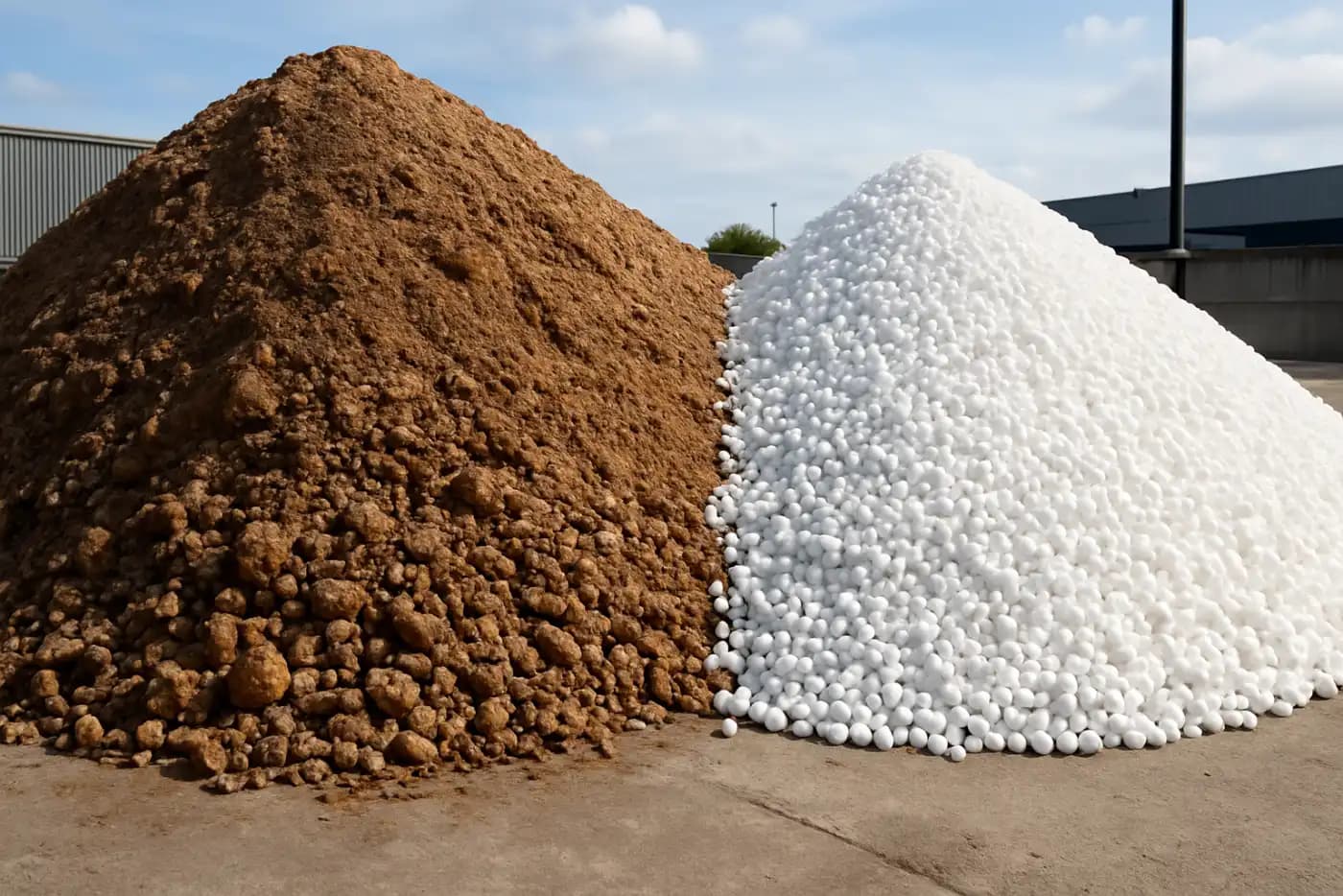
Cost and volume
plain salt is the most economical de-icer per tonne by a wide margin, which is why it is the default for high-volume road and lot work. It melts effectively down to about −9 °C, covering the majority of events in much of the country. Above that threshold there is rarely a reason to reach for anything pricier — salt does the job, and buying it in bulk on contract keeps the per-tonne cost as low as it goes.
Cold-weather performance
CaCl₂ costs more per tonne but keeps working to about −32 °C and melts faster because it releases heat as it dissolves. Below roughly −9 °C, plain salt slows down and then stops, while CaCl₂ is still actively breaking the ice bond. That is the gap calcium fills: deep cold, fast response on priority surfaces, and pre-wetting salt so it activates sooner.
Performance per dollar
The honest comparison is not price per tonne but ice melted per dollar at the temperature you actually face. At −5 °C, plain salt is unbeatable value. At −20 °C, a tonne of plain salt melts very little, so the more expensive CaCl₂ is often the cheaper way to actually clear the ice. Matching product to temperature is where real savings live.
Building a cost-effective program
For most municipalities and contractors the economical play is layered: a high-volume rock-salt base across open lanes, brine pre-wetting to cut bounce and scatter, and a faster CaCl₂ grade held back for intersections, hills, bridge decks and the coldest nights. Chloride.ca supplies both plain salt and CaCl₂ nationwide on contract volume pricing, so you can build that layered program from one account.
Surface and environmental notes
Beyond cost and cold, the two de-icers differ in how they treat surroundings. plain salt is harsher on roadside vegetation and accumulates more chloride in soil at heavy rates, while CaCl₂, applied at the lower rates its performance allows, can mean less total material on the ground for the same result. Neither should be over-applied near new concrete, sensitive landscaping or waterways. Sweeping up excess after the melt and pre-wetting to keep product on the pavement both reduce runoff. Matching the rate to the temperature — rather than defaulting to a heavy pass — is the simplest way to limit environmental load while still keeping surfaces safe.
Need a quote on bulk or bagged chloride?
Tell us the product, volume and delivery point. Most quotes go out the same business day.